Generalist Large Language Models for Tumor Genomics Interpretation
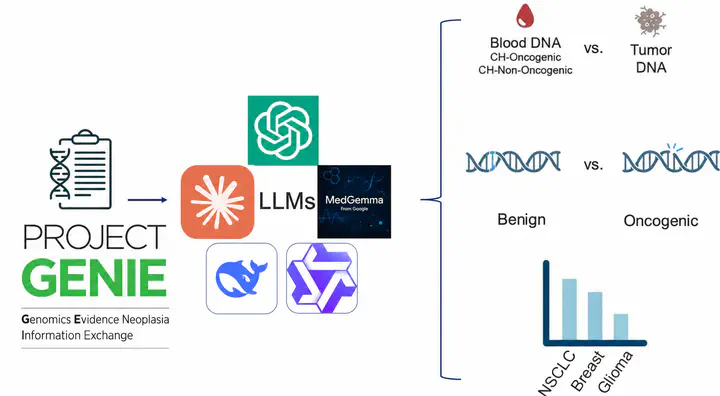 Generalist large language models applied to AACR Project GENIE tumor-genomic profiles to separate clonal hematopoiesis from tumor-derived variants, classify variant oncogenicity, and predict cancer type.
Tumor genomic profiling produces results that must be interpreted before they can guide care: what is the most likely cancer type, is a variant somatic or the result of clonal hematopoiesis (CHIP), and is it likely to be oncogenic? Specialized, tailor-made predictors exist for each of these questions, but they are trained on a single institution’s data and labels and can degrade when deployed elsewhere.
In this project, which I lead as part of my PhD work with Dr. Quaid Morris and Dr. Justin Jee at Memorial Sloan Kettering Cancer Center, we benchmark zero-shot generalist large language models against supervised baselines on cancer-type, somatic-vs-CHIP and variant-oncogenicity classification using more than 100,000 samples from 19 institutions. We find that generalist LLMs and tailor-made predictors are complementary: LLM–specialist ensembles raise cross-institution accuracy by up to 55%. The work was presented at the AACR Annual Meeting 2026 and ISMB 2026, and a preprint is available on bioRxiv.

Jennifer Yu
PhD Student in Computational Biology and Medicine
My research interests include machine learning, large language models, precision oncology and clinical time series.