About Me

Hi! I am a PhD student in the Tri-Institutional PhD Program in Computational Biology and Medicine, a collaborative effort between Cornell University, Weill Cornell Medicine, Memorial Sloan Kettering Cancer Center, and Rockefeller University. I am co-advised by Dr. Quaid Morris and Dr. Justin Jee at Memorial Sloan Kettering Cancer Center. My current research sits at the intersection of machine learning and precision oncology: I work on large language models for interpreting tumor genomics and pathology reports, and on foundation models for longitudinal clinical time series (laboratory and vital-sign measurements) that predict treatment toxicities and other adverse events for patients with cancer.

Before my PhD, I completed a Master of Science in Computer Science at the University of Toronto, where I had the privilege of being mentored by Dr. Anna Goldenberg, who is affiliated with both SickKids Hospital and Vector Institute. There, I worked on AI for digital health, including wearable time series, change point detection, graph neural networks and causal discovery for personalized pregnancy monitoring. Before that, I studied Biomedical Engineering at the University of Waterloo, where I specialized in AI and computing, which helped build a solid foundation for my current research.

As an AI4Medicine researcher, I would like to bridge the gap between AI and medicine and make an impact in the healthcare field.

Interests
  • Machine Learning for Medicine and Health
  • Large Language Models
  • Precision Oncology and Cancer Genomics
  • Clinical and Wearable Time Series
  • Computational Biology
Education
  • PhD in Computational Biology and Medicine, 2024–present

    Tri-Institutional PhD Program (Weill Cornell Medicine/Cornell University, Memorial Sloan Kettering Cancer Center, and Rockefeller University)

  • MSc in Computer Science, 2024

    University of Toronto

  • BASc in Honours Biomedical Engineering (Co-op, with Distinction), Minor in AI and Computing, 2022

    University of Waterloo

Recent News

New preprint on medRxiv
Our paper
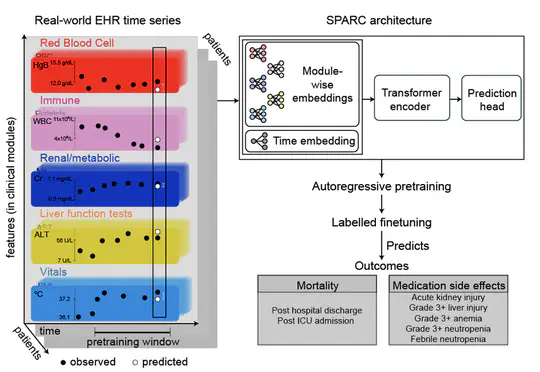
Longitudinal AI Models Predict Cancer Adverse Events, led by Chenlian Fu, is now on medRxiv. SPARC is a transformer-based foundation model trained on routinely collected longitudinal clinical measurements from 224,047 patients with cancer; it predicts treatment-related adverse events and generalizes to external cancer centers.
Best Oral Presentation at ISMB 2026!
Our work
Routine Clinical Time Series Predict Cancer Adverse Events, led by Chenlian Fu with Dr. Justin Jee and Dr. Quaid Morris, received a Best Oral Presentation award at the 34th Conference on Intelligent Systems for Molecular Biology (ISMB 2026) in Washington, DC. I also presented our abstract Large language models for tumor genomic interpretation there (now on bioRxiv as Generalist large language models complement tailor-made predictors for tumor genomics interpretation).
New preprint on bioRxiv
My first-authored PhD paper,
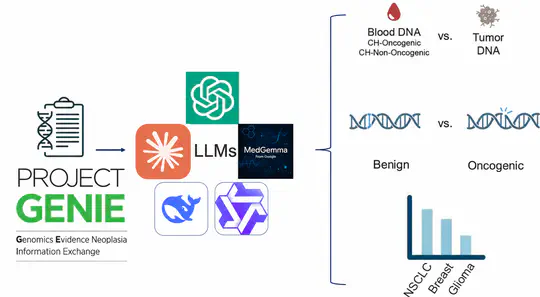
Generalist large language models complement tailor-made predictors for tumor genomics interpretation, is now on bioRxiv. We evaluate general-purpose LLMs on three real-world tumor genomic interpretation tasks and show that they match or complement specialized predictors, with the largest gains on data from new assays and institutions.
Journal publication in JMIR Formative Research
Our paper
Benefit of the N-of-1 Approach Versus Aggregate Analysis in Tracking Individual Trajectories During Pregnancy, co-first-authored with Tina Behrouzi, was published in JMIR Formative Research. Using Oura Ring and survey data from pregnant participants in the BUMP study, we show that population-level trends often fail to reflect individual pregnancy trajectories.

Recent Publications

Quickly discover relevant content by filtering publications.
(2026). Longitudinal AI Models Predict Cancer Adverse Events. medRxiv.

PDF Cite Code DOI

(2026). Generalist large language models complement tailor-made predictors for tumor genomics interpretation. bioRxiv.

PDF Cite Code DOI

Projects

*
Generalist Large Language Models for Tumor Genomics Interpretation
Benchmarking zero-shot large language models against supervised, tailor-made predictors on cancer-type, somatic-vs-CHIP and variant-oncogenicity classification across 100,000+ samples from 19 institutions, and combining them into LLM–specialist ensembles that raise cross-institution accuracy by up to 55%.
Generalist Large Language Models for Tumor Genomics Interpretation
Foundation Models for Longitudinal Clinical Time Series in Oncology
SPARC, a transformer-based foundation model pretrained on more than 100 million longitudinal laboratory and vital-sign measurements from 224,047 patients with cancer, used to predict treatment toxicities, adverse events and mortality.
Foundation Models for Longitudinal Clinical Time Series in Oncology
CodeWearBook: Agentic Natural-Language Querying of Wearable Health Datasets
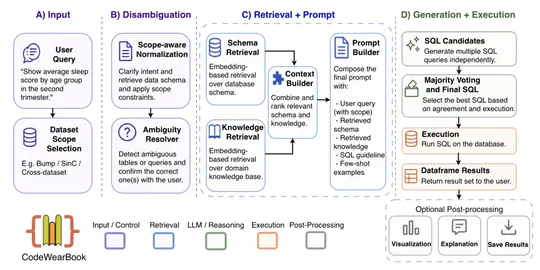
Retrieval-grounded LLM agents that let researchers query large wearable health datasets in natural language, with privacy preserved by restricting the model to controlled SQL and Python execution layers instead of raw data access.
CodeWearBook: Agentic Natural-Language Querying of Wearable Health Datasets
Automated Clinical Note Generation from Doctor-Patient Conversations using Large Language Models
The project aims to develop a top-performing large-language-model (LLM) solution for automating clinical note generation from physician-patient dialogues, thereby demonstrating the potential of LLMs in improving healthcare documentation and communication.
Automated Clinical Note Generation from Doctor-Patient Conversations using Large Language Models
Learning Limited: How limited data sharing impacts machine learning performance in health
This study finds that machine learning models trained on pooled electronic health record (EHR) data from multiple sites can generalize better to unseen data, while also revealing that data sharing partnerships may not always enhance performance, and certain baseline models continue to be competitive except in few-shot learning scenarios.
Learning Limited: How limited data sharing impacts machine learning performance in health
Model Compression
This project focuses on memory compression techniques for image compression algorithms due to the high cost of transferring data and computation between different units.
Model Compression
Time for Baby: Leveraging Wearable Data to Enhance Personalized Pregnancy Outcomes - Delivery Readiness
This research project aims to use data from wearable devices to assess delivery readiness during pregnancy on an individual basis. The study collects physiological data from pregnant women to identify specific maternal indicators that could predict delivery readiness and potentially reduce the risk of adverse outcomes for both mothers and infants.
Time for Baby: Leveraging Wearable Data to Enhance Personalized Pregnancy Outcomes - Delivery Readiness

Experiences


Memorial Sloan Kettering Cancer Center & Weill Cornell Medicine - Morris Lab & Jee Lab
Graduate Researcher (PhD)
August 2024 – Present New York, New York, USA


Enable Medicine (in collaboration with Stanford University)
Research Scholar
May 2023 – September 2023 Menlo Park, California, USA


University of Toronto, Vector Institute & SickKids - Goldenberg Lab
Graduate Researcher (MSc)
May 2022 – August 2024 Toronto, Ontario, Canada


University of Waterloo (in collaboration with McMaster University) - Vision and Image Processing Lab
Undergraduate Researcher (Capstone Project)
September 2021 – April 2022 Waterloo, Ontario, Canada


Ontario Institute for Cancer Research - Pai Lab
Computational Biology Research Intern (Co-op)
May 2021 – August 2021 Toronto, Ontario, Canada


NuraLogix Corporation (in collaboration with University of Toronto)
Machine Learning Research Intern
January 2021 – July 2021 Toronto, Ontario, Canada


University of Waterloo - Wireless Sensors and Devices Lab
Undergraduate Researcher
July 2020 – December 2020 Waterloo, Ontario, Canada

Accomplish­ments

Society of Memorial Sloan Kettering (MSK) Grant ($100,000)
The Society of MSK grant supports MSK researchers who are expanding access to pioneering clinical trials and accelerating the development of lifesaving cancer therapies.
Vector Research Grant ($4,000 × 2)
The Vector Research Grant is awarded to top-performing graduate students pursuing AI research at Vector Institute; received in 2023 and again in 2024.
Google CS Research Mentorship Program
The CS Research Mentorship Program (CSRMP) supports students pursuing computing research through mentorship from Google researchers and peer networking.
University of Toronto Graduate Fellowships
University of Toronto Tuition Fellowship ($10,000, 2022–2024), University of Toronto Top-up Fellowship ($4,000, 2022–2024) and University of Toronto Fellowship – Arts and Science ($10,000, 2022–2023), which funded my research MSc.
Vector Scholarship in Artificial Intelligence ($17,500)
The Vector Scholarship in Artificial Intelligence awarded to top students pursuing AI master’s in Ontario university, these merit-based entrance awards recognize exceptional candidates pursuing a master’s program recognized by the Vector Institute or candidates who are following an individualized study path that is demonstrably AI-focused.
Ontario Graduate Scholarship ($15,000)
The Ontario Graduate Scholarship (OGS) program encourages excellence in graduate studies at publicly-assisted universities in Ontario. Since 1975, the OGS program has been providing merit-based scholarships to Ontario’s best graduate students in all disciplines of academic study.
BioTalent Canada Work Placement Program Funding ($7,500)
The BioTalent Canada Work Placement Program Funding aims to fund high-achieving students in science, technology, engineering, mathematics (STEM), and business fields, providing them with exclusive opportunities to gain practical experience through funded work placements with esteemed employers.
NSERC Undergraduate Student Research Award ($6,000 × 3)
The Undergraduate Student Research Awards (USRA) program is administered jointly by Canada’s three research granting agencies: the Natural Sciences and Engineering Research Council of Canada (NSERC), the Canadian Institutes of Health Research (CIHR), and the Social Sciences and Humanities Research Council of Canada (SSHRC).
President’s Research Award ($1,500 × 2)
The President’s Research Award is a $1500 award available to eligible full-time undergraduate students who were recipients of the President’s Scholarship of Distinction and are interested in pursuing an on-campus research experience, under the supervision of a University of Waterloo researcher.
President’s Scholarship of Distinction ($2,000)
The President’s Scholarship of Distinction is an award given to students with 95+ admission average.

Talks & Service

Invited Talks

  • Childhood Adversity’s Impact on Dynamic Mental Health During and Post Pregnancy: A Causal Approach (lightning talk), IEEE SDS 2023 Workshop on Data Science Techniques for Datasets on Mental and Neurodegenerative Disorders, Zurich, Switzerland, 2023
  • Time for Baby: Leveraging Wearables Data to Enhance Personalized Pregnancy Outcomes – Delivery Readiness (research talk), Vector Endless Summer School: Health Roundup Seminar, Toronto, Canada, 2023

Reviewer

  • Journals: Nature Cancer (2025); JCO Precision Oncology (2025, 2026); Discovery Oncology (2026); BMC Bioinformatics (2025); Heliyon (2025, 2026); PeerJ Computer Science (2025, 2026)
  • Conferences and workshops: KDD AI for Genomics (2026); Conference on Health, Inference, and Learning – CHIL (2025, 2026); Machine Learning in Computational Biology – MLCB (2024, 2025); Machine Learning for Health – ML4H (2024); NeurIPS 2025 and ICLR 2024 Workshops on Learning from Time Series for Health; International Conference on AI & Human-Computer Interaction (2023, 2024)

Organizing

  • Student organizer, PAN-Asian Symposium on Data and AI Collaborations in Biomedicine (2026)
  • Event Organizer Lead, BioTEC Conference (2022–2023)

Mentorship

  • Supervised students during my MSc and PhD: Emily Valera and Phoebe Chuang
  • Advisor, UofT Women in STEM (2023); Mentor and Instructor, HerCode (2023)
  • Mentor, UWaterloo Engineering Student Society Resume Critique (2021); Ambassador, UWaterloo Women in Engineering (2017–2022)

Memberships

  • American Association for Cancer Research (AACR), Associate Member (2025); American Society of Clinical Oncology (ASCO), Member (2025)